


If you're getting ready to sell, you might have looked at an estate agent's fee and winced. Is it really worth that much of your money?
I've sold hundreds of homes through estate agents over the last 15 years. Along the way I've paid more than half a million pounds in fees. So I know how gut-wrenching it feels to wonder if that money was well spent.
Here are the nine things I wish I'd known before I handed all that cash over. They'll help you avoid my biggest mistakes and keep more of your money when you sell.
The cheapest estate agent fee is rarely the best deal. A good agent generates viewings proactively and can add tens of thousands of pounds to your sale price, far more than the extra fee. Judge agents on results rather than price, avoid very low fees and online agents, never pay the main fee upfront, and always negotiate.
But there's more to it than that, and the detail is where the money is.
If you want to cut right to the chase, I've designed a short quiz that works out the best way to sell your home, given your property and your priorities. It takes about 60 seconds and you get your results straight away.
Hit the button below to get started:
The 9 things I wish I knew about estate agent fees
Here's the short version. Each one gets its own section below, so you can jump to the ones that matter most to you.
- The best estate agents make you more money than they cost.
They make the pie bigger. - Rightmove is not where most buyers come from.
Good agents generate viewings in three ways. - Never avoid an estate agent just because they're expensive.
A pricier agent can save you a big price cut. - A high fee doesn't automatically mean a good agent.
Some are better at selling themselves than houses. - A low fee does mean a bad agent.
Under 1% plus VAT makes me nervous. Under £1,000, I walk away. - Don't use an online estate agent.
They can't build the local pull that brings in the best buyers. - Never pay the main fee upfront.
Once they've been paid, the agent has no reason to sell. - Always negotiate the fee.
I've not seen it lead to fewer viewings or worse service. - Use three levers to bring the fee down.
One or two phone calls can save you thousands.
Let's start with the mistake almost everyone makes, because it's the one I made for years.
1. The best estate agents make you more money than they cost
The best estate agents make you more money than they cost you. A good agent generates more viewings and stronger offers, which makes your final sale price bigger, and that extra money usually outweighs the higher fee.
Picture two pies. One has a big chunk missing. The other is missing a tiny sliver. You'd rather have the one without the chunk missing, right?
That's how most people think about estate agent fees. "A lower fee means more pie left for us."
But that's not how it works. It assumes the pie is always the same size, whichever agent you choose and whatever they actually do. But based on my experience, that assumption's the biggest mistake you can make with estate agents and fees.
Instead, I think of an estate agent like a professional service now, such as an accountant. You go to the best accountant because the idea is that they'll save you more in tax and wasted time than they cost you. It's exactly the same with estate agents.
So how do good agents make the pie bigger? Don't they all just chuck it on Rightmove and wait for the phone to ring?
2. The Rightmove misconception: how good estate agents really find buyers
Good estate agents generate viewings in three ways, and listing your home on Rightmove is only one of them. The other two are proactive: calling the buyers already on their books, and cross-selling your home to buyers who've viewed similar properties.
I call this the Rightmove Misconception, and it's the biggest myth about selling your home. If you believe it, there's a good chance you'll get fewer viewings and lower offers.
Here are the three ways a good agent brings buyers to your door:
- Your listing on Rightmove and the other portals.
This is passive. You're hoping the right buyer comes across your listing and calls in. We track where the buyers on our own sales come from, and only around 3 in 10 come directly from the portals. - Working their database.
Say your agent is selling lots of similar homes nearby. They've already had real enquiries from buyers looking for your exact type of home. A good agent calls those buyers, tells them a new one has just come up, and books them in to see yours. - Cross-selling.
A buyer views another home like yours and doesn't like it. The agent's job is to say they have something more like what that buyer is after, and book them in to see yours.
Those two proactive things generate around 70% of our sales. They're how a good agent actually earns their fee.
And here's why it matters to your pocket. There's not a few hundred quid at stake here. When the job is done properly, I've seen the difference run to tens of thousands of pounds.
It can be the difference between you having to knock £10,000 off your asking price to generate some interest... versus having two buyers fighting over your home and pushing the price up.

Top tip: How your sale is managed has a huge impact on your final selling price, and the right agent can grow your pie by a lot. I cover how to find that kind of agent in my guide on how to sell your house fast for the best price.
So how do you decide what's actually worth paying in estate agent fees, and what's a waste?
3. Never avoid an estate agent just because they're expensive
Never rule out an estate agent just because their fee is higher. With so much money at stake when you sell, it matters far more that the job is done well than done cheaply. The pricier agent is often the one who saves you a big price reduction.
I spoke with a seller a few weeks ago who'd been stuck for six months with barely any viewings. Every time he asked his agent why, they said it was quiet at the moment.
Funny thing, though...
When I looked at the market, similar homes were selling fine. In fact, most of them were being sold by one particular agent.
When I suggested he try that agent, he said he'd already been in touch with them. They were £2,000 more expensive...
This lovely chap was about to knock £25,000 off his asking price. There was a really good chance a slightly pricier agent could have helped him avoid that.

Related: If your home has been sitting for months with barely any viewings, the problem is often the agent rather than the market. My guide on when you should change estate agents walks you through the signs.
So high fees are good then, right? Well, not quite.
4. A high estate agent fee doesn't automatically mean a good agent
A high estate agent fee does not automatically mean the agent is good. Some agents are brilliant at selling themselves and selling you a high fee, but that doesn't mean they're as good at selling properties.
When I first realised how much agents affect the final price, I stopped wanting cheap ones. I sought out the most expensive agents instead, because I thought they'd make me the most money.
Here's what I learned after paying dozens of them...
Some agents are brilliant at selling themselves. But based on what I've seen, that doesn't necessarily mean they're as good at selling houses...
It was an expensive lesson.
So a high fee tells you the agent is confident. It doesn't tell you they'll get you a better price.
So what about low fees then? This is where I have really strong views.
5. A low estate agent fee does mean a bad agent
A low estate agent fee almost always means a worse result. Low-cost agents have no budget for the proactive work that generates viewings, so they hire less experienced staff and spread them thinly across more properties. What you save in fees, you tend to lose several times over on your sale price.
Believe me, having paid so much to estate agents over the years I'd have loved low-fee agents to be the answer. I'd have saved a fortune.
But the best agents grow the pie with the proactive stuff they do. With a low-cost agent, there's no budget for that extra work. So they hire less experienced people and spread them thin over more properties. Your results suffer.
The best agents grow the pie with the proactive work they do. But with a low-cost agent, there's no budget for that extra work.
So yes, you might save £5,000 in estate agent fees. But you'll never know if that cost you £15,000 on your sale price, because nobody ever sees that bill.
Based on everything I've seen, I believe what you lose is likely to be much more than what you save. So in my opinion, a low fee does automatically mean a bad agent. I wouldn't touch one for my own or a client's sale.
So what counts as a low fee? Here's how I think about it. For a normal high street agent:
- Under 1% plus VAT.
If that's their starting fee, before you've even tried to negotiate, I get nervous. - Under £1,000.
At that level I'm running a mile. A cheap agent will cost you more than they save you.
Here's how the two types of agent tend to compare:
If you're chasing the lowest cost above everything else, my video on how to save £1,000s on estate agent fees is a good place to start.
And while we're on the topic of cheap, what about online agents?
6. Should you use an online estate agent?
I'd avoid online estate agents. They've had more than ten years to take over and are still only used by around 5% of sellers. They can't build the local pull that draws buyers in, and their low fees leave no room for the proactive work that gets you the best price.
Back when online agents first launched, everyone said they were the future and that they'd replace high street agents.
Today, they're still only used by around 5% of sellers, about 1 in 20...

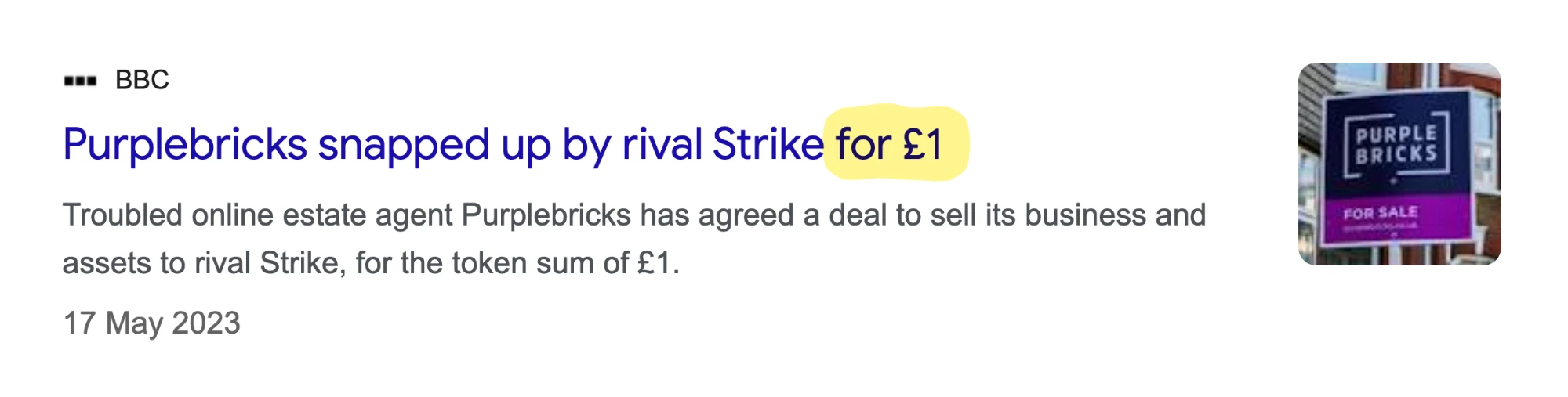
And the online agent that got the biggest, Purplebricks, ended up collapsing and was sold for £1 in 2023.
So why didn't they take off? Two reasons, and they both come back to how good agents actually sell:
- No local gravity.
The best local agents get results by having lots of similar listings in one area. Each one acts as a little magnet that pulls in buyers. They end up with a rich database to work, and cross-selling opportunities. Online agents are scattered across the whole country though, so they can't build that pull. - No budget for matchmaking.
They're low cost, so they can't do the hands-on work of calling buyers and cross-selling afterwards. They put it on Rightmove, Zoopla and so on, and hope the phone rings.
That's why they don't deliver the same results, even after a decade of trying.
If you're weighing up potentially using Yopa at the moment, I've done a full breakdown on whether Yopa is actually any good.
Now, while we're on Purplebricks, there's one more thing to learn from them. They set a trap that still exists today, and it can slow down your sale and cost you money even if you never sell...
7. Never pay the main estate agent fee upfront
Never pay an estate agent's main selling fee upfront. Once an agent has been paid whether they sell your home or not, they have no reason to sell it. In most cases it will cost you in the long run. Small costs for photos or ID checks are fine. The main fee is not.
Do you remember the Purplebricks "commisery" adverts? They were all over TV in the late 2010s...
In this one, two ladies had both just sold their homes. One did it 'the smart way' and paid a low Purplebricks fee. The other (with cake on her face) did it 'the silly way' and paid a high street agent's commission.

The point was to convince you that commission is bad. So instead of paying when your estate agent actually sells your home, you should just pay Purplebricks a flat fee up-front (whether they sold it or not).
Does that feel a bit strange to you? It should...
Everyone paid a flat fee of around £1,000 upfront. Then the home went on Rightmove and whatever happened, happened.
The money's gone whether you sell or not. And according to research at the time, they only sold about half of the properties they took on.
And it's not surprising...
For an agent who's already been paid, do they care? They've little reason to.
To be clear, some upfront costs are unavoidable and I end up feeling they're pretty reasonable...
Here's my take:
- Professional photos and a floor plan.
Maybe around £300. I'm fine with that if they're good. - ID checks.
Could be around £50. I don't love it, but I'm okay with it. - The main selling fee.
Never upfront. Paying it early removes the agent's reason to sell.
So an agent quotes their fee. Should you try to knock it down, and will it backfire?
8. Should you negotiate estate agent fees?
You should negotiate your estate agent's fee. I almost always negotiate fees and I haven't seen fewer viewings or worse service as a result. Once you're in an agent's system, your property gets handled like every other one, and if you push too low they can simply say no.
There's an argument that if we pay these guys less, they won't try as hard. So we sell for less and end up worse off overall.
But here's what I've found...
I'll almost always negotiate fees, and I haven't seen fewer viewings or worse service because of it.
I'll almost always negotiate fees, and I haven't seen fewer viewings or worse service because of it.
It sounds backwards, but here's why I think it doesn't matter:
- Once you're underway with an agent, your property just gets handled like every other one...
- Nobody in the office is keeping track, and deciding to spend 25% less time on your sale because you're paying 25% less.
The other thing...
If you push too low, the agent can just say no. You can then go ahead at the fee they're happy with. There's no downside to asking.
So with estate agent fees being so expensive, how do you actually bring them down?
9. How to negotiate estate agent fees: the three levers
You can bring an estate agent's fee down with one or two phone calls by pulling three levers. Remind them there are cheaper alternatives, show them you're a must-sell seller, and commit to a realistic asking price. Each one makes you a more valuable client, so they're more willing to take you on for less.
This is super easy, and you don't have to be good at haggling. All three levers work the same way: they make you a more valuable customer, so we're putting it in the agent's interest to drop the fee to win your business.
Here are the three levers - and if you want more detail I do a full run-through in this video: How I save £1,000's on estate agent fees.
- Lever 1: cheaper alternatives exist.
The agent wants your business, and they know there are cheaper options out there, from online agents to cheaper local rivals. Mentioning this gently puts you in control and the agent on the back foot. - Lever 2: you're a must-sell seller.
Here's a stat most people don't know. Estate agents only sell about half of the properties they take on. The rest get withdrawn or moved to another agent. So every new listing is a 50/50 bet on the agent's time. Show them you're serious and won't change your mind, and you become a far more valuable customer. - Lever 3: a realistic asking price.
Overpriced homes are the other place agents waste time. They hang around, they're harder to sell, and they make the agent look bad. Tell the agent you'll set a realistic asking price based on their valuation, and they'll see a very high chance of a sale. Again, you're worth more to them.
(By the way, if you want to sell your home quickly and for its full value, then a realistic asking price is one of the most important things to get right. Recent Rightmove data proves it: properties priced correctly first time around find a buyer in 36 days, whereas home needing one or more price reductions take 127 days on average.)
Put those three together in one or two calls and most agents will move on the fee. You're simply showing them why you're a customer worth having, so don't feel guilty or awkward about trying.

Fair Warning: Please use these levers honestly. If you're just testing the market, or you're not serious about setting a realistic asking price, don't say you are. Leave that lever out and use the others.
One more thing, because it matters more than any single lesson here...
Which estate agent should you actually choose?
Choosing an estate agent isn't about paying as little as possible. It's about agreeing a fair fee with the agent who'll do the best job of selling your home. The right agent adds far more to your sale price than the fee difference ever costs you.
Everything above comes down to that one idea. The fee is the price of the job. What matters is who's doing the job, and how well.
So pick the agent who's selling homes like yours right now, who works their buyers, and who has the people to do it properly. Then use the three levers to agree a fair fee with them.
And if you're still deciding how to sell at all, I've designed a free 60-second quiz. It points you to the best selling method for your property and your priorities, and you get personalised advice straight away.
Thanks for reading, and hit the button below to get started:
Estate agent fees: your questions answered
Here are the questions I get asked most often about estate agent fees:
How much are estate agent fees in the UK?

Most high street estate agents in the UK charge a percentage of the sale price, typically somewhere around 1% to 1.5% plus VAT, and it's usually negotiable. Fees vary by area and by agent. Having dealt with 1,000+ agents over the years, I'd treat anything under 1% plus VAT as a warning sign rather than a bargain.
Are cheap estate agents worth it?
A cheap estate agent usually costs you more than they save. A low fee leaves no budget for the proactive work that generates viewings, so the agent has less experienced staff spread across more homes. You might save £5,000 in fees, but lose £15,000 on your sale price without ever seeing that bill.
Can you negotiate estate agent fees?
Estate agent fees are negotiable, and I negotiate them on almost every sale. I haven't seen it lead to fewer viewings or worse service. The three levers that work are pointing to cheaper alternatives, showing you're a must-sell seller, and committing to a realistic asking price. If you go too low, the agent can simply say no. You can watch exactly how I do it in my video on how I save £1,000s on estate agent fees.
Should you pay estate agent fees upfront?
The main selling fee should never be paid upfront. Once an agent has been paid whether or not they sell your home, they have little reason to sell it. Small upfront costs, such as around £300 for professional photos and a floor plan or around £50 for ID checks, are reasonable if the work is good.
Are online estate agents any good?
Online estate agents are still only used by around 5% of sellers after more than a decade, and the biggest one, Purplebricks, collapsed and was sold for £1. They can't build the local pull that draws buyers in, and their low fees leave nothing for proactively calling buyers and cross-selling. For most sellers, a good local agent gets a better result.
Do more expensive estate agents get a better price?
A higher fee doesn't guarantee a better price. Some agents are excellent at selling themselves and a high fee, but not as good at selling houses. What does get a better price is an agent who's selling similar homes nearby, works their database of buyers, and cross-sells your home to them. Judge an agent based on that, not on the fee.
By Matthew Cooper, Co-Founder of Home Selling Expert

I'm an experienced property insider, trusted media commentator, and the Founder of Home Selling Expert and YesHomebuyers.com. I've bought and sold almost 150 properties worth nearly £17m, and my advice articles (like this one!) have been viewed more than 1million times.
Auction Valuation & Consultation
- Free referral to my #1 Leading Auction House in your area
(Take the time & guesswork out of shopping around) - Get all your auction questions answered for free...
(...by experienced auction experts I know and trust) - Free, no-obligation auction valuation within 48 hours
(Find out what your property may be worth at auction)

Sell Your Home By Auction?
- Don't settle for a slow and frustrating sale...
- Just 2 minutes to determine if auction's right for you...
- And receive my free, personalised guidance on your sale.
(Including free introductions to leading auction houses I know and trust)

Sell Your House By Auction?

Chain-Free Property Sale?
- Explore proven chain-free alternatives...
- Avoid property chain stress and uncertainty...
- Get free, personalised advice for a smoother sale.
to a House Buying Company?
- A free, no-obligation cash offer within 24 hours...
- ... and buy your house in as little as 7 days.
- But are they right for you? Find out in the next 2 minutes.
to a House Buying Company?
- A free, no-obligation cash offer within 24 hours...
- ... and buy your house in as little as 7 days.
- But are they right for you? Find out in the next 2 minutes.
Just good advice. Click below to chat with me:
Broken House Chain?
- A free, no-obligation cash offer within 24 hours...
- ... and buy your house in as little as 7 days.
- But are they right for you? Find out in the next 2 minutes.
Get Back on Track Quickly
- Explore fast and reliable alternative selling methods...
(which are tailored to your situation) - Receive free expert guidance on navigating your sale
(overcome the challenges of a broken property chain) - Free introductions to local property experts I know & trust
(for a hassle-free sale next time around)
Fast Selling Solutions for Free...
- Discover fast and reliable alternative selling methods.
(Explore your options with no cost or commitment) - Receive a free action plan tailored to you...
(...based on your priorities, property and timeframes) - BONUS: Learn to avoid common mistakes + save £1,000s...
(By using our FREE "Inherited Property Pitfalls" download)
Fast Selling Solutions For Free
right for you?
- A free, no-obligation valuation within 48 hours...
- ... and sell your house in as little as 6 weeks.
- But are they right for you? Find out in the next 2 minutes.
right for you?
- A free, no-obligation valuation within 48 hours...
- ... and sell your house in as little as 6 weeks.
- But are they right for you? Find out in the next 2 minutes.
Sell Your Home
- Explore fast and reliable alternative selling methods...
(which are tailored to your situation) - Discover the ideal way for you to sell...
(Based on your property & priorities) - Free introductions to local property experts I know & trust
(for a hassle-free sale)
Sell Your Home?
- Discover fast and reliable alternative selling methods.
(Explore your options with no cost or commitment) - Receive a free action plan tailored to you...
(...based on your priorities, property and timeframes) - Get free introductions to handpicked, trusted companies.
(Avoid stress & save time with our recommendations)
See if Auction is right for you...
- Avoid the biggest mistakes subsidence sellers make...
- Don't settle for a slow and frustrating sale...
- Find out how to maximise your sale price, and minimise headaches.
See if Auction is right for you...


.svg)


